
TCS Prism™
A Strategy Framework for Constrained Supply Markets
In balanced markets, procurement creates value through leverage. In constrained markets, procurement creates value through security, resilience, access, and strategic alignment.
How do we secure the greatest security value for the cost incurred?
One Strategy. Multiple dimensions of supply security
Why Traditional Strategic Sourcing Fails In Constrained Supply Markets
Strategic Sourcing was developed during a period of globalization where supplier competition drove lower prices.
In today's constrained supply markets it is driven by:
- Government Policy
- Geopolitics
- Capital Flows
- Supply Constraints
- Capacity Availability
The Global Era of economic interdependence is over!
Global supply chains are being redesigned for local and 'friend shoring' 'from allied' low risk jurisdictions, driven by re-industrialization, the AI build out and the resulting unprecedented demand for energy and critical materials.
The result is tight supply, structural deficits and a phenomenon most of today's buyers have never experienced.
A Sellers Market.
The core question is no longer:
“How do we optimize price?”
It is:
"How do we gain preferential access to scarce resources — and what does that security actually cost and deliver?"
The TCS Prism™ Solves The Problem
Traditional procurement collapses strategy into a single dimension: cost.
TCS Prism™ refracts a single strategy into four interdependent dimensions of security:
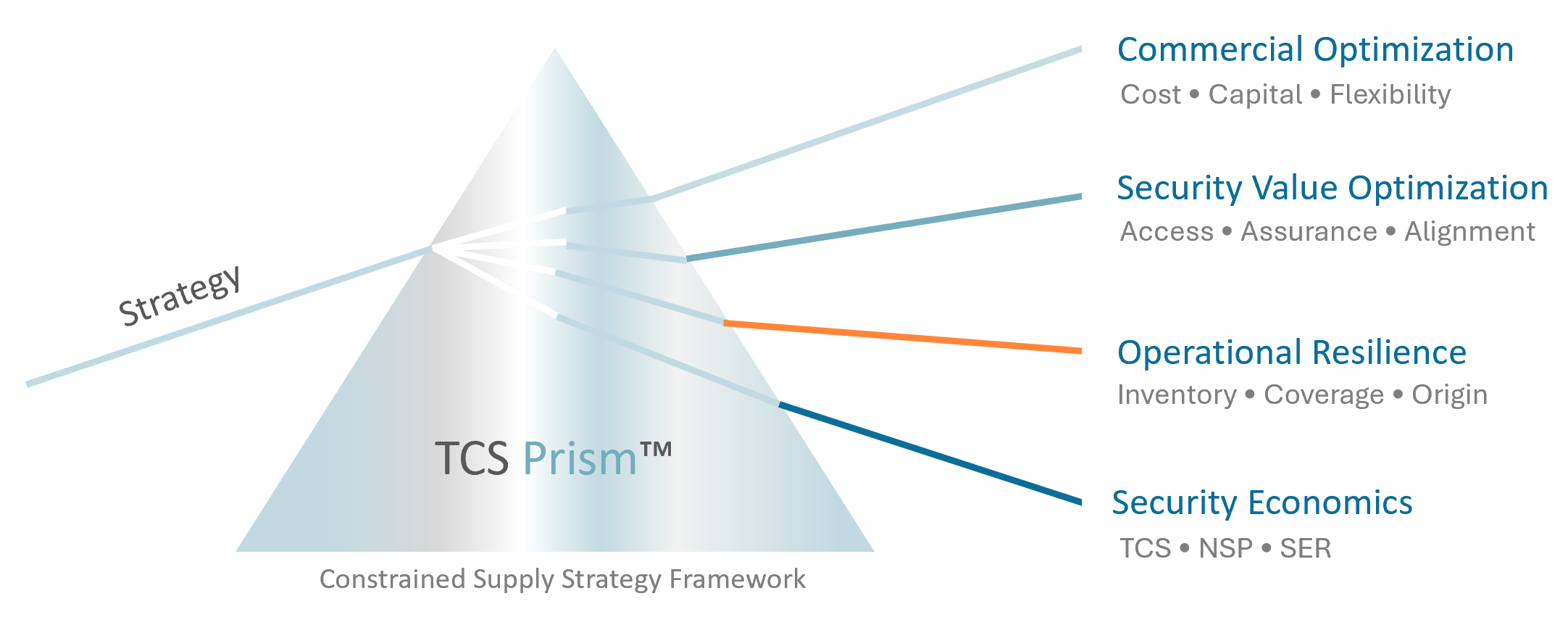
The TCS Prism™ separates strategy decisions from evaluation outcomes:
Strategy:
- Commercial Optimization —
Structuring cost, capital, leverage, and flexibility around security
- Security Value Optimization —
Deliberately creating the right type and level of security
Evaluation:
- Operational Resilience —
Current-state ability to absorb supply shocks — and the resilience standard against which proposed strategies are stress-tested
- Security Economics —
Quantified cost, value, and efficiency of the security position
TCS Prism™ designs strategy across two domains — Commercial Optimization and Security Value Optimization — and evaluates every option against the organization’s current Operational Resilience and the economic performance measured by Security Economics (TCS metrics).
The Traditional Discussion
Fuel Manager: We need longer-term contracts and higher inventory.
CFO: That increases cost. Why not stay closer to the market?
Fuel Manager: Because of security and access risk.
CFO: Can you quantify that?
The conversation stalls. Strategy remains qualitative and difficult to defend.
The TCS Discussion
Fuel Manager: We evaluated three strategy options through the Prism.
- Option A optimizes near-term cost but leaves us exposed on physical coverage and origin risk.
- Option B strengthens Physical Security and Structural Alignment at a measurable premium.
- Option C balances Value Assurance with Supply Chain Integration and delivers the highest overall security efficiency under stress-test conditions.
CFO: Now we can see the trade-offs across dimensions and choose deliberately.
Strategy becomes multi-dimensional, comparable, and board-defendable.
The conversation is no longer about whether security is needed. It is about which combination of commercial and security choices delivers the best overall position — and why.
TCS Prism™ is the strategy design and evaluation layer within the Total Cost of Security ecosystem.
Use it to:
Supply Security Strategy
Structure multi-dimensional security strategies
Sourcing & Inventory
Compare alternative sourcing and inventory postures
Economic Outcomes
Translate qualitative security arguments into board-ready economic outcomes
Explore the TCS Prism™ within the TCS Engine™ or through Strategic Advisory.
Explore:
Explore TCS™ Solutions:
Solution
Executive Toolkit
TCS Engine™
Strategic Advisory
Compare
Purpose
Understand your current security position
Evaluate alternative security strategies
Validate critical procurement decisions
Compare TCS™ Capabilities