

When Supply Security Becomes a Funding Decision What the CPO commits, the CFO has already paid for. Physical material simply makes the capital visible. Executive Summary & Key Takeaways The Core Disconnect: CPOs secure positions, but CFOs fund them. In a constrained market, an unfunded commitment is an illusion. Category vs. Portfolio: A global portfolio can look fully covered while … Read More
Allocation Rules: How Preferred Customer Status Becomes Physical Supply
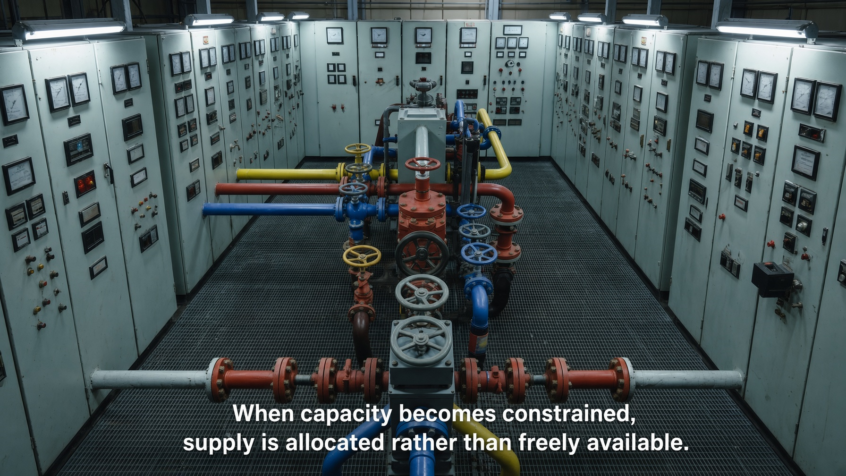
Allocation Rules: How Preferred Customer Status Becomes Physical Supply In every constrained market, allocation rules determine who receives supply when capacity becomes scarce. Nuclear fuel provides a particularly clear example because uranium, conversion, and enrichment markets operate under long lead times, limited surplus capacity, and high barriers to entry. The same commercial mechanisms appear wherever demand exceeds available supply, from … Read More
Critical Minerals: The same tonne cannot serve two strategies

Critical Minerals: The same tonne cannot serve two strategies Industrial policy is booking demand for minerals the physical economy may not deliver. Category teams still have to secure a slice of that contested tonne and put a price on what that security costs. Western industrial strategy now speaks fluently in two languages: money and carbon. It is far less fluent … Read More
The Supplier Relationship Imperative: Building Preferred-Customer Status as a Core Resilience Pillar in Constrained Nuclear Fuel Markets

The Nuclear Fuel Market Today Looks Uncomfortably Similar to Automotive Chips in 2020/21 In a market where physical access has become the binding constraint, Supplier Relationship Management is no longer optional soft-skill work. It is a measurable component of Total Cost of Supply Security. Introduction: From Price Optimization to Access Security For much of the past two decades, nuclear fuel … Read More
Quantifying Nuclear Fuel Security: Applying the Total Cost of Security (TCS™) Framework

From theoretical risk to board-ready economic outcomes — how leading fuel buyers measure, justify, and optimize the true cost of supply resilience. Introduction: The Nuclear Renaissance Meets Procurement Reality Across North America, policy makers are increasingly positioning nuclear energy as a cornerstone of long-term energy security, grid reliability, and decarbonization. New reactor projects, life extension programs, small modular reactor (SMR) … Read More
From Policy to Procurement: What North American Nuclear Strategies Really Mean for Fuel Buyers
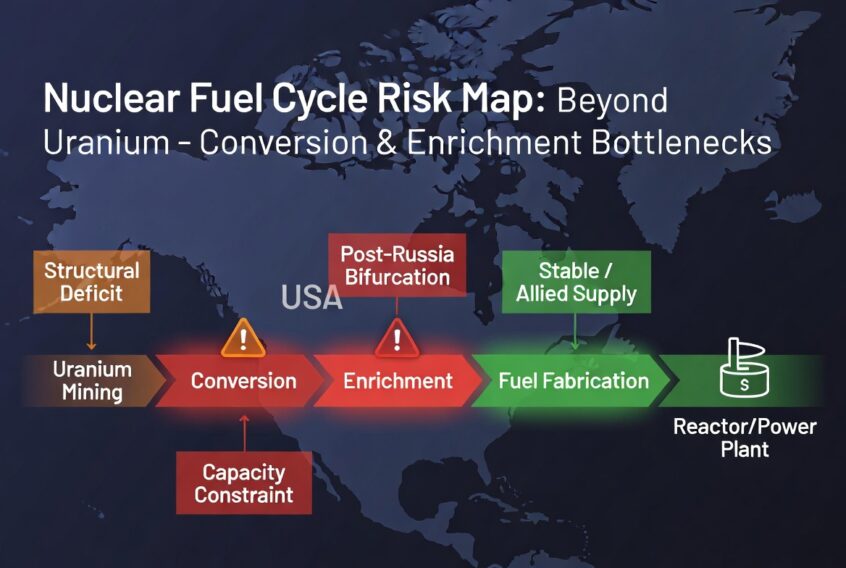
Uranium Procurement Strategy in a Supply Deficit Market: How nuclear fuel buyers secure uranium supply in a tightening market. The near simultaneous release of Canada’s Nuclear Energy Strategy and the United States’ 2026 National Defense Strategy marks a clear geopolitical shift: North America is prioritizing secure, allied nuclear fuel supply chains in an increasingly fragmented global market. For governments, this … Read More
Building a Resilient North American Supply Chain

Why procurement leaders must act now in the AI and energy era Executive Brief North American supply chains are undergoing a structural reset. What’s changing Driven by geopolitical competition, industrial policy, and AI-led energy demand, the United States is no longer relying on markets alone—it is actively designing supply chains. Canada, through resource depth and integration, is emerging as a strategic extension of that … Read More
Delivering MAT Through CFP:

Delivering MAT Through CFP: A Practical Guide for Category Managers The Procurement Act 2023 introduces two transformative changes: Most Advantageous Tender (MAT) replaces MEAT (section 19) Competitive Flexible Procedure (CFP) (section 20) replaces rigid legacy procedures with tailored, proportionate competition For category managers, this is an opportunity to move beyond lowest-price compliance toward structured processes that deliver genuine value for money, public benefit, and whole-life … Read More
Competitive Flexible Procedure: Mastering the Procurement Act 2023

Competitive Flexible Procedure: Opportunity, Risk and the Route to Strategic Excellence A New Era for UK Public Procurement The Procurement Act 2023 is the most significant reform of public procurement law in a generation. Receiving Royal Assent on 26 October 2023 and coming into force on 24 February 2025, it sweeps away the old EU-derived straitjacket and replaces it with … Read More
Procurement Act 2023: Category Playbook 2.0

How to Embed the Procurement Act 2023 Directly into Your Category Management Process A practical, no-fluff guide for Category Managers, Heads of Procurement, and Transformation Leads Nine months after go-live (24 February 2025), one thing is clear: the Procurement Act 2023 has turned category management from a back-office function into one of the most powerful levers of domestic policy available … Read More