Prevent category errors that drive sourcing, hedging and negotiations against the wrong market
Most category strategies begin with suppliers and spend. Markets begin with the clock. When those don't match, procurement, treasury and finance work from different definitions of the same market.
Ideal For
- Critical minerals category managers
- Procurement teams using hedging
- Treasury managing commodity exposure
- Nuclear fuel procurement teams
- Teams struggling to define Spot and Term
Lets Talk
The Problem
Most category files start with a spend cube and supplier list. Markets start with a pricing clock. When the clock is wrong, sourcing strategies, price benchmarks and hedge positions are built on the wrong commercial object.
- “Spot” is used for LME Cash, for a regional physical premium, for Fastmarkets APT, and for a broker’s Ux print. Those are not the same price.
- “Term” is used for a locked cathode premium, a TC/RC, a conversion fee, and a negotiated all-in. Those are not the same negotiation.
A Category Manager's category is rarely the commodity name. It is the market-facing category they actually buy, the pricing clock they negotiate against, and the point they occupy in the value chain.
People call all of these "Spot"
- LME Cash
- Regional Premium
- Fastmarkets APT
- Broker UX Price
But they are:
❌ Different markets
❌ Different negotiations
❌ Different risk positions
Get that wrong, and every subsequent premium, hedge, coverage metric and forecast describes a category that does not exist in the market.
The Solution
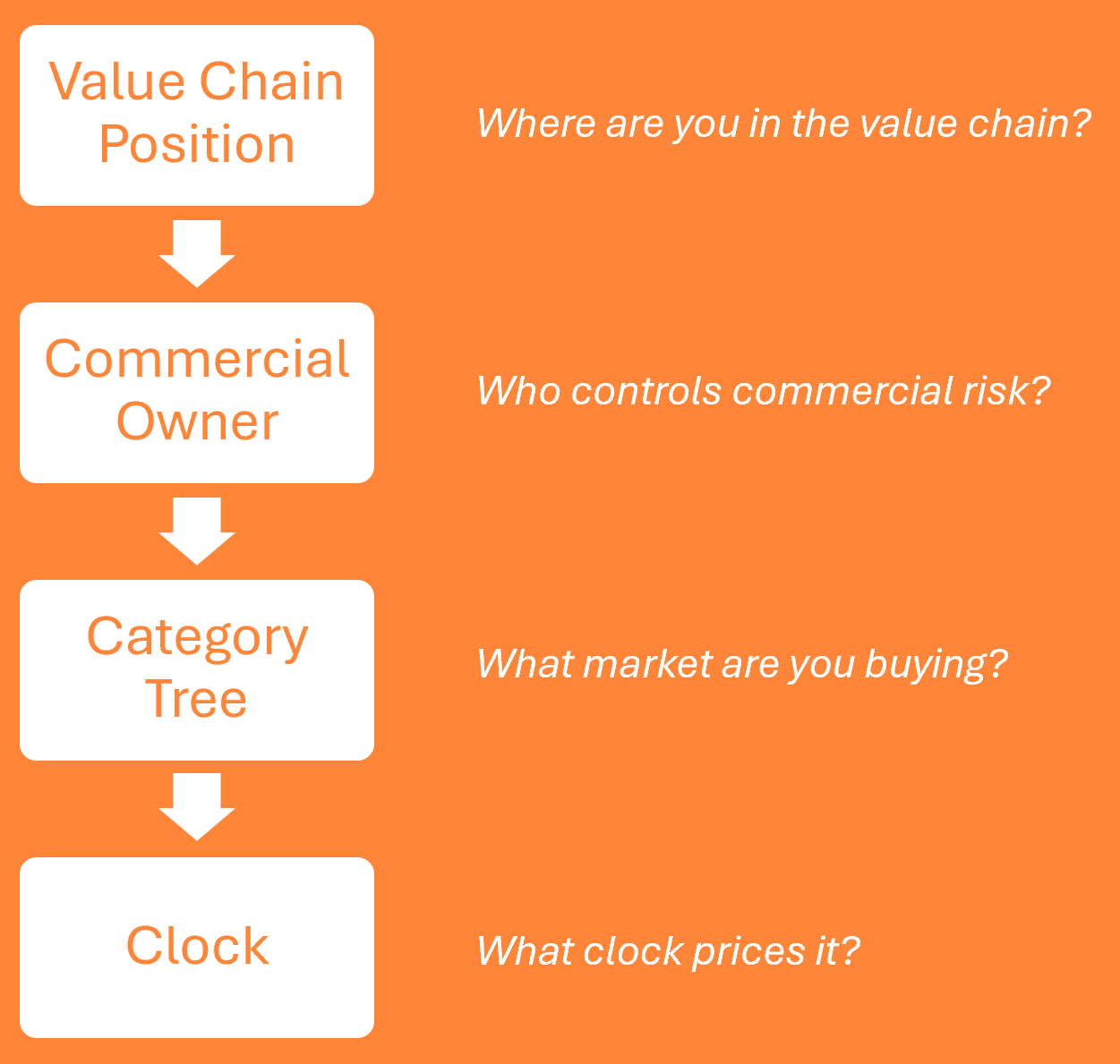
The Category Profile™ defines the market before you analyse it. It identifies the parent category, child categories, pricing clock and commercial structure the TCS Engine™ is permitted to ingest.
The result is a single, agreed definition of how the category is commercially controlled.
It is a product in its own right, use it to define your critical minerals category. It does not require the TCS Engine™, it is what keeps it honest when you use it.
What it does
- Defines the parent category and its market-facing child categories
- Identifies the pricing clock (exchange, index or bilateral)
- Defines what Spot and Term actually mean
- Identifies whether value is negotiated as metal, premium, fee or process charge
- Prevents spend and scrap credits being grouped incorrectly
The method is the same for all critical minerals.
Why it Matters
Category errors do not stay in category management. They flow into sourcing strategies, market intelligence, hedge positions, budget assumptions and supplier negotiations. When the commercial object is wrong, every subsequent decision is built on a flawed foundation.
A category error does not just distort reporting.
It can misdirect sourcing effort, hedge activity, market intelligence and executive decision-making for years.
How it Works
Value even if you never open the TCS Engine
A completed Profile becomes the organization's agreed definition of how the category is commercially controlled.
- Treasury hedges the correct object.
- Procurement negotiates the correct object.
- Finance reports the correct object.
- The board receives one definition of the market.
- Market intelligence tracks the correct object.
The Category Profile™ was created to solve a recurring problem observed in metals, minerals and energy procurement: different functions often use different definitions of the same market.
Four Prices Called "Spot". Four Different Markets
What the Profile decides
Parent Category
Child Categories
Clock
Commercial Structure
- One file.
- One Seat.
- The Engine Portfolio
- The sourcing/RFP objects
- A second file if the supplier is split
- What Spot and Term
- What the hedge is
- Buy a finished product
- Buy processing services
- Buy metal plus conversion
- Split time from material cost
Three clocks. Not three methodologies.
Clock
The Metal Price
What You Negotiate
Examples
- Commodity Exchange
- Index
- Bilateral
- Paper + place + premium
- Named PRA print
- All-in spot and term
- Fab, TC/RC, scrap discount, shape
- Coefficient, collar, formula on the index
- Term price or process fee
- Copper - seven parent categories
- Tungsten concentrates, APT powders
- Nuclear fuel four stages; tungsten tools
The Clock is how the metal is priced. What you negotiate is separated, it does not change the clock. Copper cable is still Exchange. Tungsten APT is Index. Treating them as the same book is the error the Profile exists to stop.
What the Review Delivers
-
Completed Profile workbook covering the parent category and up to four child categories.
- A completed Profile detailing how the category is commercially controlled.
-
Written rationale for the category structure and pricing clock.
-
Executive-ready commercial control statement for Procurement, Treasury and Finance sign-off.
-
Optional path into TCS Toolkit™ or TCS Engine™ using only Live columns.
Where it sits in the TCS ecosystem
- TCS Executive Toolkit™: Measure the current security position.
- TCS Category Profile™: Define the book before defining the KPI.
- TCS Engine™: Design and stress alternative strategies on that book.
- TCS Advisory™: Independent challenge and board memorandum.