

Why procurement leaders must act now in the AI and energy era

Executive Brief
North American supply chains are undergoing a structural reset.
What’s changing
- Driven by geopolitical competition, industrial policy, and AI-led energy demand, the United States is no longer relying on markets alone—it is actively designing supply chains.
- Canada, through resource depth and integration, is emerging as a strategic extension of that system.
- AI is driving structural demand for energy and materials
For procurement leaders, this is not background noise.
It is a short window to secure long-term advantage.
Early movers will lock in access, resilience, and price stability. Late movers will face constrained and premium supply.
1. From Market Forces to Managed Supply Chains
The United States has shifted decisively toward intervention.
Through mechanisms such as:
- Defense Production Act (DPA)
- Inflation Reduction Act (IRA)
- Direct funding and equity participation
…it is actively shaping supply chains across critical sectors.
The IRA alone embeds strict sourcing requirements, mandating that increasing proportions of critical minerals come from the US or FTA partners (including Canada), rising toward 80% by 2027.
It is also backed by hundreds of millions in DPA funding to accelerate domestic and allied supply chains. [spglobal.com] [barr.com]
In parallel, the US is now taking direct equity stakes in mining companies, including:
- ~10% in Trilogy Metals
- ~5% in Lithium Americas
…marking a significant shift toward state-backed industrial supply chains. [energypoli…lumbia.edu]
From lowest-cost global sourcing → to security-driven, allied supply chains
Procurement insight
Global arbitrage is no longer sufficient.
Geopolitical alignment is now a core sourcing decision variable.
2. Canada: The Strategic Extension of US Supply
Canada’s positioning is unique—and increasingly central.
US legislation such as the IRA and DPA already treats many Canadian firms as “domestic” supply sources. [mintz.com]
This reflects:
- tight economic integration under USMCA
- the need to reduce reliance on China, which controls ~60% of production and 85% of processing capacity in critical minerals [mintz.com]
Canada’s resource base is extensive:
- produces 22 of 34 identified critical minerals
- generated $70+ billion in mineral output (2023)
- supported by multi‑billion investment programs and sovereign funding mechanisms [investcanada.ca]
Government strategy is explicit:
“Critical minerals are the building blocks of the green and digital economy” [canada.ca]
Canada is no longer a secondary sourcing option—it is a strategic pillar of North American supply chains.
Capital Is Following Policy
Policy alignment is now driving capital flows.
Canada’s critical minerals strategy has already unlocked:
- $18.5+ billion in investment tied to strategic supply chains [canadianmi…report.com]
- major infrastructure funding and incentives across the value chain [publications.gc.ca]
At the same time, US funding is increasingly being deployed across:
- domestic supply
- Canadian assets
- allied projects globally [bhfs.com]
However, this growth is selective—not uniform.
Winning projects typically demonstrate:
- Regulatory momentum
- Indigenous partnership alignment
- Direct linkage to US supply chains
Structural constraints remain:
- permitting complexity
- infrastructure gaps
- labour shortages
Procurement insight
Future supply will not expand evenly.
Access will favor early, aligned engagement—not late-stage buying.
3. The AI–Energy–Materials Convergence
A critical force is accelerating demand across the system:
AI is rapidly becoming a major driver of energy and commodity demand.
Data centre expansion is transforming the energy landscape:
- Data centers consumed ~4.4% of US electricity in 2023, projected to reach 6.7–12% by 2028 [energy.gov]
- Electricity demand from data centers is expected to double by 2030, with AI the main driver [iea.org]
- US data center power demand could reach ~11.7% of total demand by 2030 [mckinsey.com]
At the same time:
- hyper-scalers are committing hundreds of billions in capital to infrastructure [forbes.com]
- grid constraints and supply bottlenecks are already emerging
AI may appear digital—but it is fundamentally physical: power, metals, infrastructure.
Procurement insight
Procurement teams are no longer competing within categories.
They are competing within system-wide demand cycles driven by AI, energy, and industrial policy.
4. The North American Advantage Stack

Figure: The structural drivers reshaping North American supply chains
The emerging model can be understood as a reinforcing system:
How it works
- Policy sets direction (IRA, DPA)
- Capital follows aligned priorities
- Assets concentrate in stable geographies
- Procurement secures long-term access
“Competitive advantage now comes from aligning across all four layers—not optimizing within one.”
What Could Disrupt This Trend?
The trajectory is clear—but not guaranteed.
Key risks include:
- policy shifts in US industrial strategy
- Canadian execution delays
- capital reallocation if returns under perform
- continued permitting and infrastructure bottlenecks
At the same time, broader global dynamics remain unstable:
- supply chains have already been disrupted by geopolitical shocks and trade fragmentation [bakerinstitute.org]
- reshoring and near-shoring trends are accelerating in response [reshorenow.org]
Procurement insight
Resilience now requires:
-
scenario-based sourcing strategies
-
diversified supply portfolios
-
flexibility in contracting structures
5. Action Agenda for Procurement Leaders
This is an execution window—not an observation period.
-
Map exposure
Quantify dependence on high-risk geographies and identify where strategic categories can transition toward North American supply.
-
- Identify dependency on high-risk geographies
- Assess North American substitution options
-
Engage upstream early
Secure access before markets tighten by building direct relationships with producers and locking in future supply options.
-
- Build relationships with producers and developers
- Explore:
- off-take agreements
- co-investment or strategic partnerships
-
Reframe cost models
Shift from price optimization to resilience optimization—embedding risk, continuity, and alignment into sourcing decisions.
-
- Move beyond price to include:
- resilience
- security of supply
- geopolitical alignment
- Move beyond price to include:
-
Extend contracting horizons
Protect against volatility by locking in supply through multi-year agreements and structured pricing mechanisms.
-
- Deploy multi-year agreements
- Integrate index-linked pricing
- Secure guaranteed volumes
-
Track leading indicators
Stay ahead of the market by tracking policy, capital flows, and project pipelines—not just prices and supplier performance.
Focus monitoring on:
-
- USMCA developments and trade alignment
- US funding flows and policy updates
- Canadian permitting reforms
- major project financing decisions
6. What This Means for Category Managers
This shift can be understood through a revised category strategy model:
The traditional Kraljic framework assumed relatively stable and abundant supply markets.
That assumption is increasingly invalid.
As supply becomes more constrained and policy-driven, a growing number of categories are shifting toward strategic supply positioning, this builds on Kraljic but reflects a structural shift in markets.
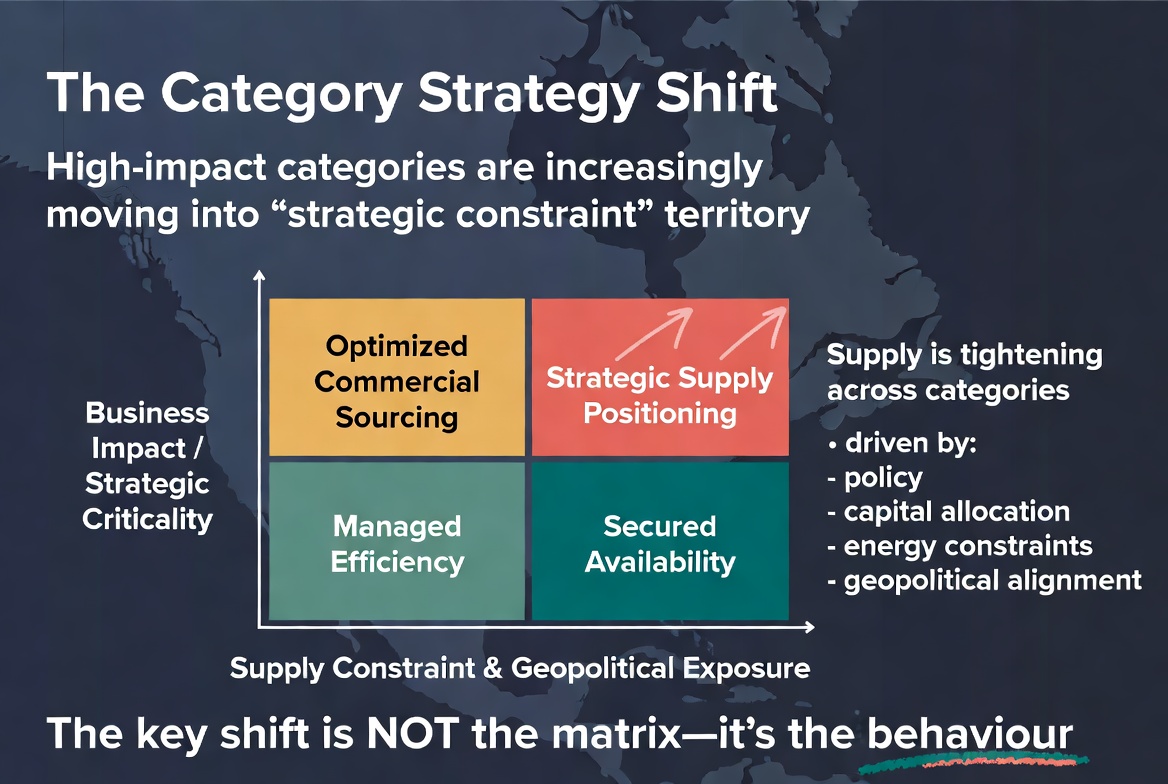
Figure: Category management is shifting from cost optimization to securing strategic position within constrained and policy-driven supply markets.
While the structural shifts in North American supply chains are strategic in nature, their impact will be felt most directly at the category level.
“For category managers, this is not a future issue. It is a current change in how categories need to be managed, sourced, and secured.”
From sourcing efficiency to supply positioning
Category strategies built primarily around:
- cost optimization
- global competition
- short-term flexibility
…are becoming increasingly exposed.
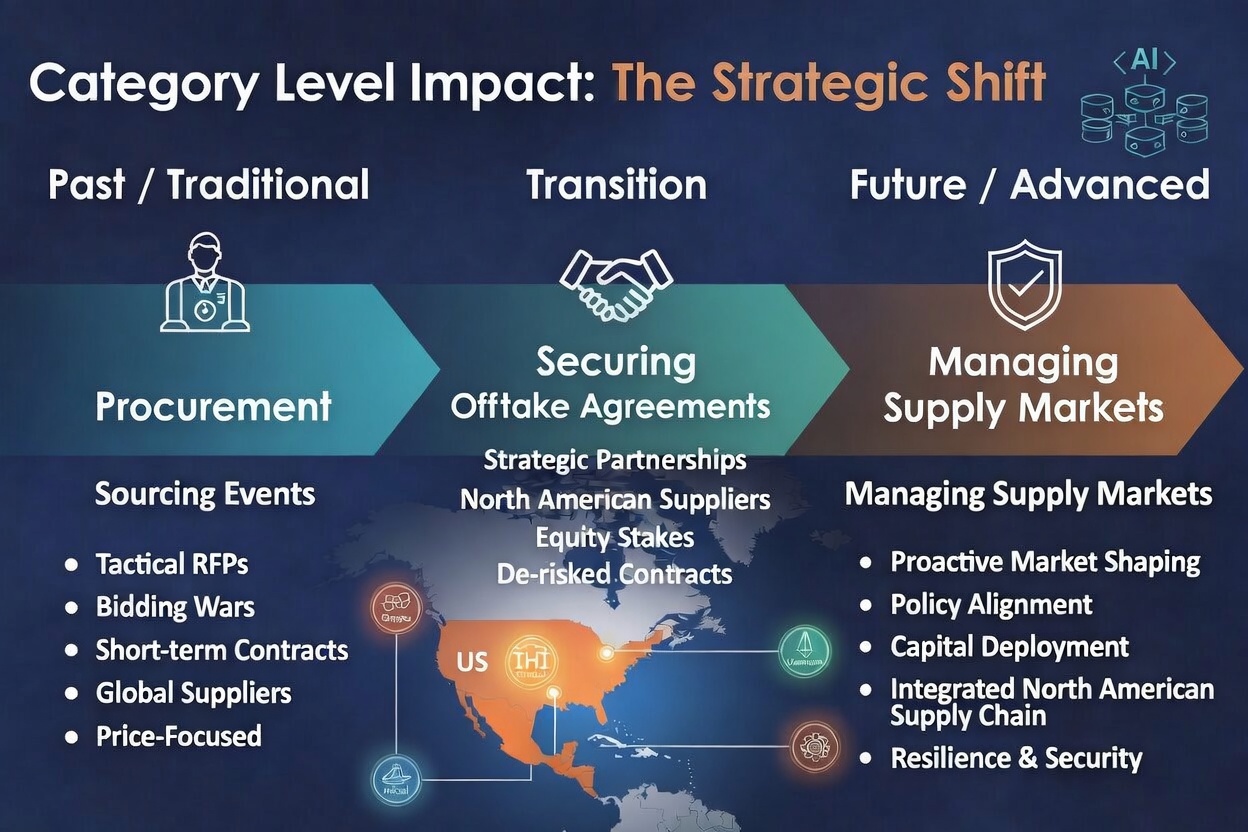
Instead, category managers must now prioritize:
- security of supply
- geographic alignment
- long-term access to constrained inputs
“The role shifts from optimizing spend to securing position within supply-constrained markets.”
Earlier engagement in the supply chain
In critical categories—particularly:
- metals (copper, nickel, lithium)
- energy and power
- engineered components
…procurement is already moving upstream.
“For example, a manufacturer sourcing copper for electrification infrastructure may need to secure long-term agreements with North American producers rather than relying on global spot markets.”
This means:
- engaging suppliers before projects are operational
- understanding project pipelines, not just supplier performance
- assessing which suppliers are aligned with US and Canadian policy priorities
“Access will increasingly be determined years before formal sourcing events.”
Changing contracting strategies
Traditional sourcing models—spot buying, short-term frameworks, frequent rebidding—are less effective in constrained markets.
Category managers will need to increase use of:
- multi-year contracts
- index-linked pricing mechanisms
- volume commitments or off-take-style agreements
These structures may appear less flexible, but in practice they:
- secure capacity
- reduce volatility
- improve supplier prioritization
“In tight markets, suppliers allocate to committed buyers—not opportunistic ones.”
Reframing supplier relationships
Supplier segmentation must evolve beyond spend and performance criteria.
New strategic dimensions include:
- geopolitical alignment (US/Canada vs exposed jurisdictions)
- access to capital and funding support
- position within strategic supply chains
Category managers should treat key suppliers as:
- long-term partners
- co-developers of supply
- sources of market intelligence
“Supplier strategy becomes as important as sourcing strategy.”
Greater exposure to macro and policy signals
Category management is no longer insulated from macroeconomic shifts.
Critical inputs will increasingly be influenced by:
- industrial policy decisions
- trade agreements (e.g. USMCA developments)
- infrastructure and permitting timelines
- energy market dynamics
This requires category managers to:
- monitor policy as actively as price trends
- integrate external signals into category planning cycles
“The best-performing category managers will operate with a market view, not just a supplier view.”
Implications for category strategy design
As a result, category strategies should evolve to include:
- dual or regional sourcing models
- explicit risk-adjusted cost frameworks
- pipeline visibility (3–5 years, not 12–18 months)
- alignment with corporate resilience priorities
Bottom line for Category Managers
“Category management is no longer about running sourcing events—it’s about securing position in constrained markets.”
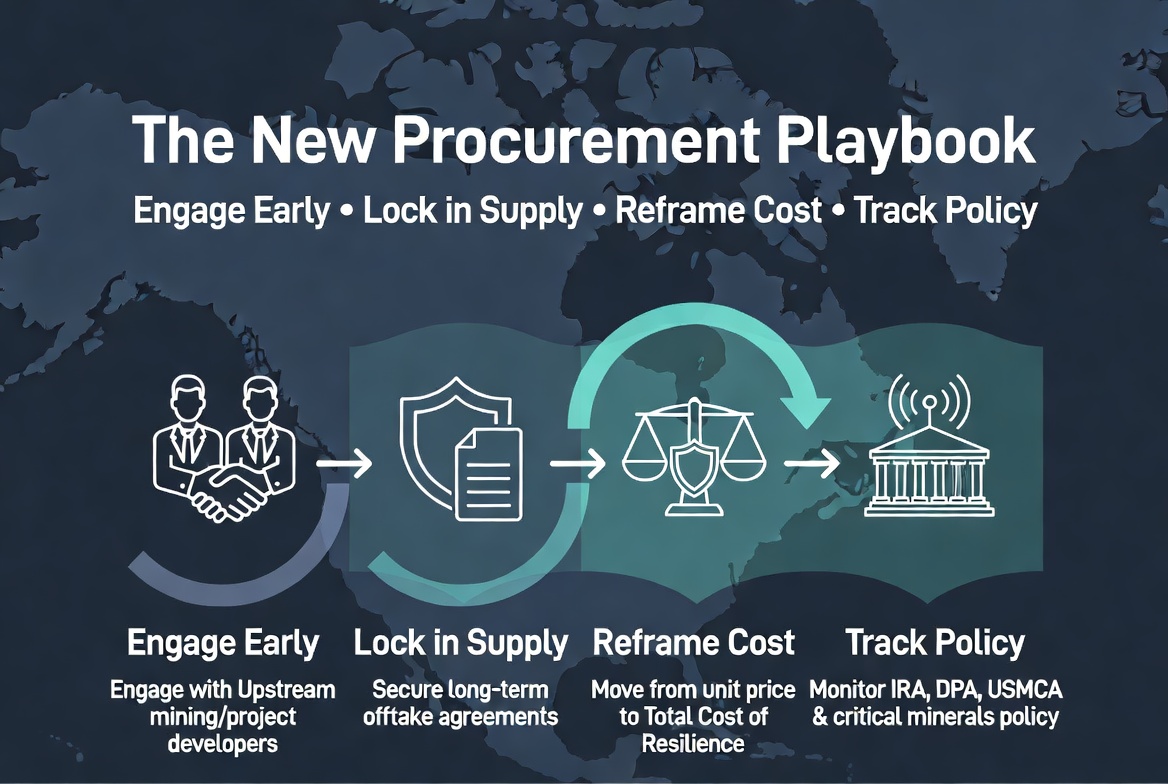
Those who adapt their approach:
- engage earlier
- contract differently
- align with structural market shifts
…will secure more stable supply, better pricing over time, and greater strategic influence within their organizations.
Those who do not will increasingly operate in reactive, constrained markets with limited leverage.
7. Final Perspective: Procurement as Strategic Positioning
North American supply chain integration is no longer theoretical—it is operational.
USMCA trade flows alone now account for hundreds of billions in annual trade, with Canada and Mexico collectively absorbing roughly one-third of US exports. [brookings.edu]
“This is not about managing disruption. It is about securing position.”
Organizations that align sourcing strategies with:
- policy direction
- capital flows
- supply concentration
…will build structural advantage.
“The organizations that recognize this early will operate with advantage. The rest will operate with constraint.”
Nuff said …
Purchasing Practice Insight
This article forms the foundation of a broader series examining related topics impacting the procurement agenda.
Related Articles:
Related Resource:
Uranium Procurement Strategy: In a Constrained Supply World™