
Uranium Procurement Strategy in a Supply Deficit Market:
How nuclear fuel buyers secure uranium supply in a tightening market.
The near simultaneous release of Canada’s Nuclear Energy Strategy and the United States’ 2026 National Defense Strategy marks a clear geopolitical shift: North America is prioritizing secure, allied nuclear fuel supply chains in an increasingly fragmented global market.
For governments, this is a matter of sovereignty and resilience.
For nuclear fuel buyers, it is far more immediate: how to secure reliable volumes in a structurally constrained market where suppliers—not buyers—set the terms.
The strategic direction is clear. The execution challenge now defines success.
This Is Not Just a Uranium Market Story
Much of the current narrative focuses on uranium supply deficits. While directionally correct, this framing is incomplete—and potentially misleading for procurement leaders.
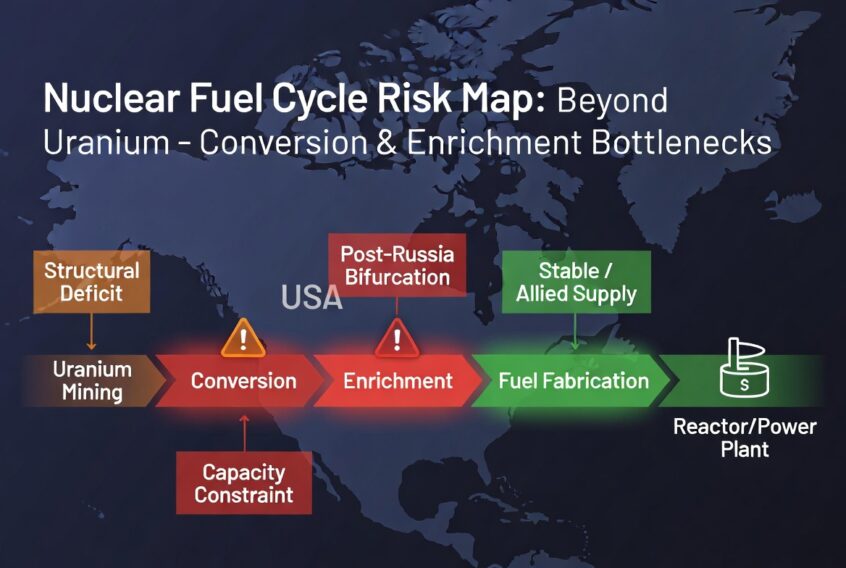
The more immediate constraints sit downstream in the fuel cycle:
- Conversion capacity is limited and still recovering in the West
- Enrichment availability is tightening rapidly, particularly post-Russia restrictions
- Lead times across the fuel cycle are extending simultaneously
For US light-water reactor fleets, enrichment remains the critical vulnerability. Canada’s reliance on natural uranium via CANDU technology provides relative insulation, but that advantage is not transferable.
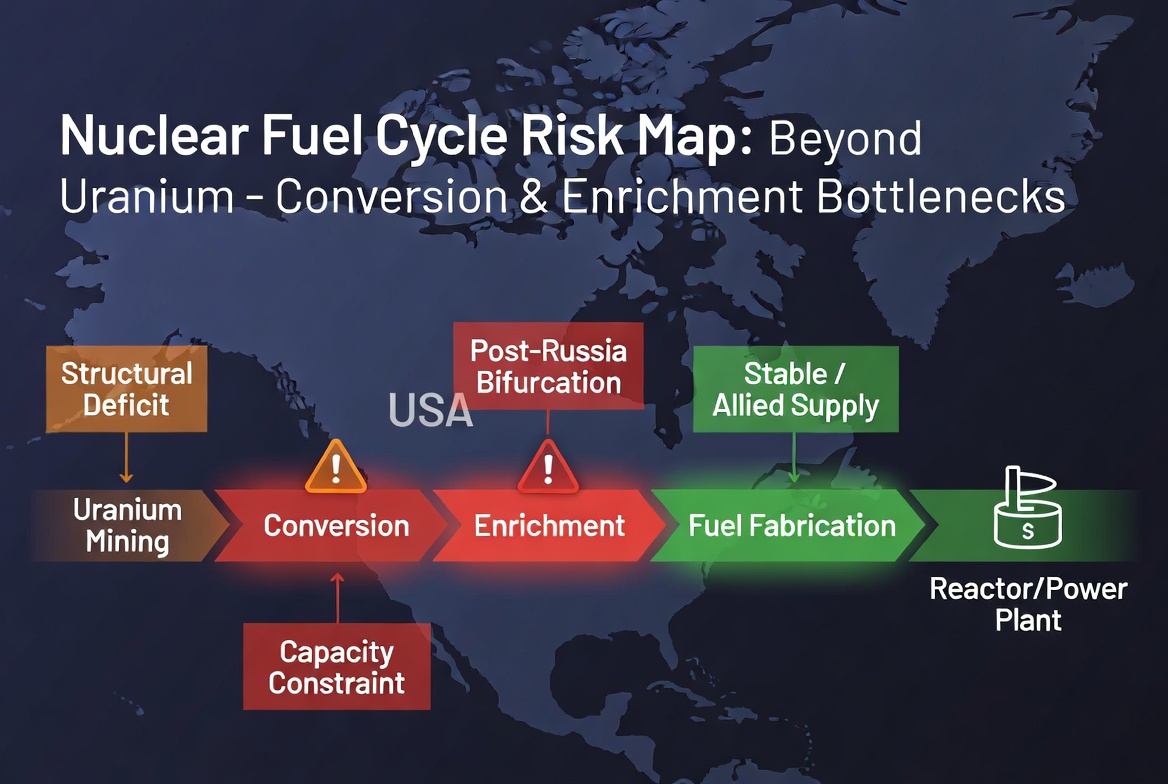
Nuclear Fuel Cycle Risk Map
Implication:
Procurement strategies must evolve from uranium sourcing to integrated fuel cycle management, treating uranium, conversion, and enrichment as a single risk portfolio.
Policy Alignment: Strategic Signal, Not Commercial Leverage
Canadian and US policy alignment is real and meaningful:
- Reduced reliance on non-aligned suppliers
- Strengthened allied supply chains
- Support for domestic and regional production
However, from a buyer’s perspective, policy alignment does not:
- Guarantee access to supply
- Prioritize domestic utilities in allocation
- Reduce pricing pressure in competitive markets
Uranium producers remain commercially driven. In a tightening market, they will allocate volumes based on:
- Contract strength
- Counter-party quality
- Economic return
—not geopolitical alignment alone.
The reality for CPOs:
Policy influences long-term supply development, but contracts secure near – and mid-term supply. In today’s environment, procurement strategy must focus on execution certainty rather than policy proximity.
The Supply Growth Gap: Ambition vs Bankability
Government strategies reference expanded output, increased investment, and long-term capacity growth—particularly in Canada’s Athabasca Basin.
These ambitions are credible. But they are not immediate.
New uranium supply faces structural constraints:
- Long permitting and development timelines (often 8–12 years)
- Complex Indigenous engagement and ESG requirements
- Capital intensity and financing hurdles
- Skilled labor and infrastructure limitations
Even brownfield expansions carry execution risk and timeline uncertainty.
For procurement teams, the distinction is critical:
There is a difference between:
- Announced supply
and
- Contracted, deliverable volumes within planning horizons
Procurement strategies must be anchored in the latter.
The Shift to a Seller’s Market
One of the most important structural changes is the re-balancing of market power.
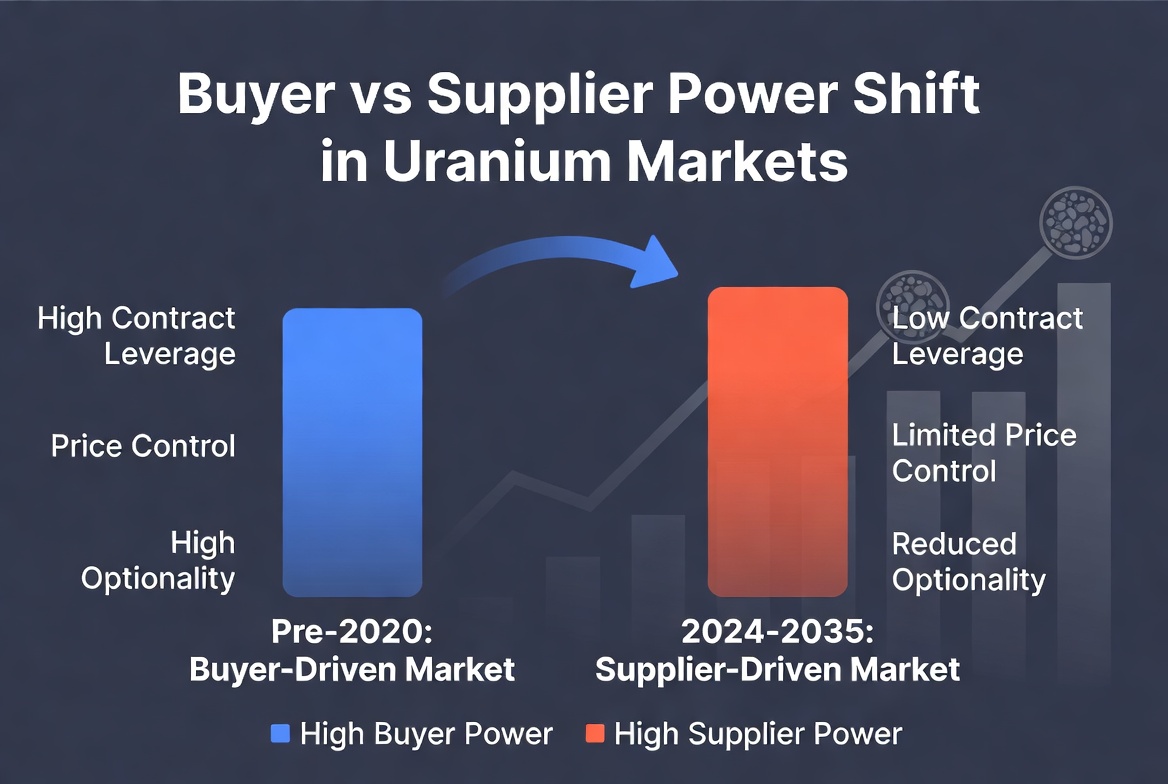
Buyer vs Supplier power Shift in Uranium Markets
In the past, buyers could:
- Optimize timing
- Leverage spot markets
- Negotiate favorable contract optionality
That environment has fundamentally changed.
Today:
- Suppliers have stronger negotiating leverage
- Contract terms are tightening
- Optionality is narrowing
- Competition for Tier-1 supply is increasing
Even well-positioned utilities are competing for long-term volumes with:
- Other utilities
- Strategic investors
- Governments indirectly shaping demand
This is no longer a price-led procurement environment—it is an access-led market.
What Winning Procurement Looks Like Now
In a structurally constrained market, success is defined by resilience, not just cost efficiency.
1. Portfolio Resilience is Non-Negotiable
A balanced mix is essential. Leading fuel buyers are adopting portfolio-based strategies that layer:
- Long-term contracts for baseline security
- Mid-term flexibility for adaptability
- Strategic inventory buffers
- Limited, tactical spot exposure
Over-reliance on any single lever increases risk. (See Portfolio Strategy Wheel graphic).
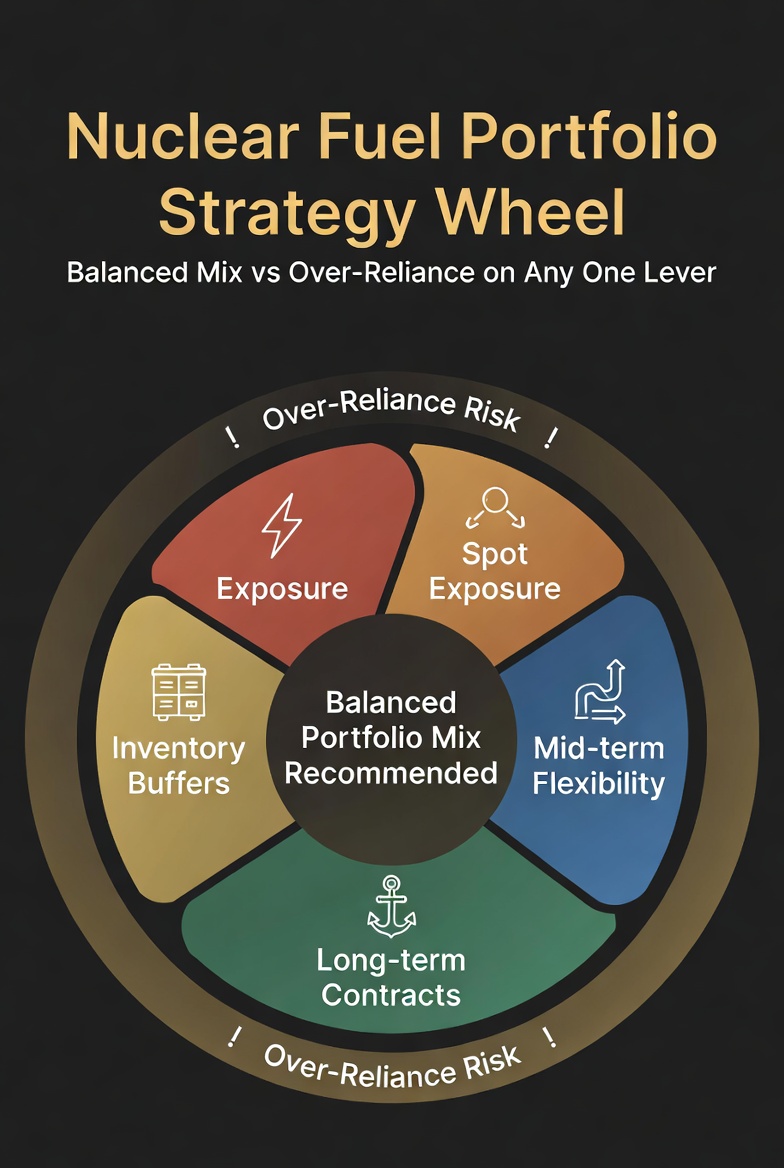
Nuclear Fuel Portfolio Strategy Wheel
The objective is diversification across:
- Time horizons
- Suppliers
- Pricing structures
This reduces dependence on any single contract or market condition.
2. Contracting Discipline in a Tightening Market
With supplier leverage increasing, contract design becomes critical.
Key considerations include:
- Price mechanisms: balancing market exposure with downside protection
- Volume commitments: securing sufficient base load while retaining limited flexibility
- Delivery scheduling: managing timing risks across the fuel cycle
- Counter-party strength: prioritizing reliability over marginal cost benefits
Buyers should expect:
- Reduced flexibility in negotiations
- Stronger producer protections
- Greater emphasis on credit risk and financial standing
In this environment, contract quality—not just contract coverage—is a defining capability.
3. Geopolitical Alignment
Drives Supplier Selection. Canadian uranium offers clear advantages: high-grade reliable supply, strong safeguards, and policy support for allied markets. US buyers should treat Canada as a strategic Tier-1 partner in diversification away from higher-risk sources.
4. Inventory as a Strategic Asset
Inventory has shifted from a passive buffer to a core strategic lever.
Utilities with strong balance sheets are using inventory to:
- Bridge contracting gaps
- Manage delivery timing risks
- Reduce exposure to supplier-driven constraints
In a deficit market, inventory provides:
- Immediate optionality
- Procurement timing flexibility
- A hedge against both price and availability risks
For many CPOs, inventory decisions are now as important as contracting decisions.
5. Managing the Full Fuel Cycle Risk Stack
Procurement risk now spans the entire fuel cycle:
| Category | Primary Risk | Strategic Response |
| Uranium | Supply concentration | Diversified term contracts |
| Conversion | Limited Western capacity | Early booking, long-term commitments |
| Enrichment | Structural shortage post-2028 | Multi-supplier strategies, allied sourcing |
| Logistics | Trade and transport disruption | Scenario planning and contractual safeguards |
This integrated risk management approach is essential. Focusing on uranium alone leaves significant exposure unaddressed.
6. Timeline Risk is Accelerating
Demand growth is outpacing supply additions through 2040, creating widening procurement exposure. Early movers securing Canadian supply will gain significant competitive advantage.
Canada–US Synergy: Real but Conditional
There is clear strategic alignment between Canada and the United States:
- Canada offers resource depth, political stability, and export potential
- The US provides demand scale and capital
This creates a strong foundation for collaboration.
However, from a buyer’s perspective, this synergy is conditional, not guaranteed.
It depends on:
- Successful project execution
- Infrastructure expansion across the fuel cycle
- Regulatory and trade alignment
Until these translate into tangible capacity, buyers must treat them as strategic upside—not committed supply.
The Strategic Trade-Offs Procurement Must Manage
The current market introduces a set of unavoidable tensions:
- Security of supply vs cost efficiency
- ESG and Indigenous participation vs speed of execution
- Policy alignment vs commercial flexibility
For example:
- Allied sourcing reduces geopolitical risk but may increase cost exposure
- Strong ESG requirements support long-term sustainability but can extend timelines
- Long-term contracts provide security but reduce flexibility
There are no perfect solutions. The role of procurement is to actively manage these trade-offs, not eliminate them.
The Often Overlooked Risk: Demand Uncertainty
While much focus is placed on supply constraints, demand risk remains a critical variable.
Buyers must consider:
- Reactor life extension decisions
- SMR deployment timelines
- Regulatory and licensing uncertainties
- Power market volatility
Demand is not entirely predictable, and over commitment carries its own risks.
Best-in-class procurement balances both sides:
- Securing supply in a deficit market
- Maintaining sufficient flexibility to accommodate demand shifts
The Missing Link: Availability vs Cost
Much of the current focus in nuclear fuel procurement is on availability—how to secure sufficient volumes in a tightening market.
However, availability and cost are becoming increasingly inseparable.
As supply constraints intensify, securing material is not simply a question of coverage, but of the terms required to obtain it. Pricing structures, supplier alignment, flexibility provisions, and inventory strategies all begin to carry a cost that is not captured in traditional procurement models.
The practical implication is clear: the challenge is no longer just whether supply can be secured, but what it will require to secure it.
Conclusion: From Market Awareness to the Cost of Security
The structural shift underway in nuclear fuel markets is increasingly well understood. Supply is tightening, geopolitical alignment is reshaping trade flows, and the balance of power has shifted toward suppliers.
But understanding the market is no longer the differentiator.
The more difficult question for procurement leaders is what these dynamics will require them to do—and what it will cost.
Most utilities can describe the deficit and identify their uncovered requirements over time. Far fewer can quantify the true cost of securing supply in a constrained market. Procurement strategies are still often evaluated on price and coverage, without fully accounting for the cost of ensuring delivery, flexibility, and continuity of operations.
As market conditions tighten, this gap becomes more material. Securing supply is no longer simply a matter of contract coverage—it involves trade-offs across pricing structures, supplier alignment, fuel cycle constraints, and inventory positions. The resulting cost is not captured in traditional sourcing models.
Leading organizations are beginning to recognize this shift. Rather than focusing solely on price optimization, they are considering the total cost of securing supply—integrating reliability, access, and risk mitigation into procurement decision-making.
This represents a fundamental change in approach: from procurement as a cost management function to procurement as a mechanism for securing operational continuity.
In July, we will publish a detailed procurement brief that builds on these themes, focusing on how procurement strategies can be assessed in terms of the cost required to close supply gaps in a constrained market environment, and introducing our proprietary Total Cost of Security (TCS™) Framework for measuring fuel security economics.
For procurement leaders, the question is now becoming unavoidable:
Not simply whether supply is constrained—but what it will cost to secure it
Nuff said ….
Related Resources:
Understand the Market: Insight Brief™
Understand Your Position: TCS Executive Toolkit™
Evaluate Alternatives: TCS Engine™
Compare TCS™ Capability Options
Validate Critical Decisions: Strategic Advisory™