

Allocation Rules: How Preferred Customer Status Becomes Physical Supply
In every constrained market, allocation rules determine who receives supply when capacity becomes scarce.
Nuclear fuel provides a particularly clear example because uranium, conversion, and enrichment markets operate under long lead times, limited surplus capacity, and high barriers to entry. The same commercial mechanisms appear wherever demand exceeds available supply, from copper and tungsten to semiconductors, aerospace forgings, transformers, and rare earth magnets.
Allocation rules are the contractual mechanism that turn a supplier relationship into physical delivery.
The Hidden Test of Preferred Customer Status
Many buyers talk about supplier relationships. Allocation rules reveal whether those relationships have real commercial value.
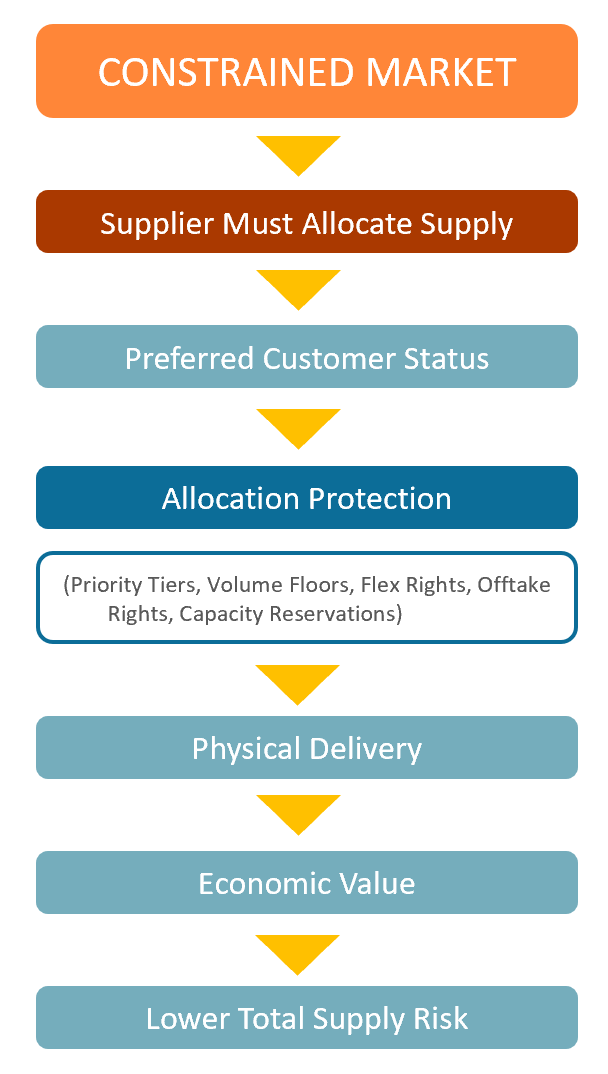
When capacity becomes constrained, supply is allocated rather than freely available.
The true test of Preferred Customer Status is not what appears on a supplier scorecard. It is what happens when the market cannot satisfy every customer.
| Relationship Status | Typical Allocation Position | Likely Outcome During Constraint |
| Preferred Customer | Priority allocation, volume floors, flex rights | Higher delivery assurance |
| Strategic Customer | Partial protections and higher allocation priority | Reduced exposure to shortages |
| Transactional Buyer | Standard pro-rata allocation and capped volumes | Greater exposure to curtailment |
| Spot Buyer | No protected allocation position | Highest exposure to shortages |
Nuclear Fuel Is Not Unique
The principle is often discussed in the context of nuclear fuel because the consequences of supply interruption are visible and severe. Yet the same logic governs any constrained market.
- A copper rod mill operating at full capacity allocates production among customers.
- A tungsten processor facing feedstock shortages allocates APT and carbide volumes.
- Semiconductor foundries allocate wafer starts.
- Defence contractors allocate specialist forgings and castings.
The details differ.
The commercial question does not:
When available capacity cannot satisfy every request, which customers receive volume first, and why?
Allocation rules provide the answer.
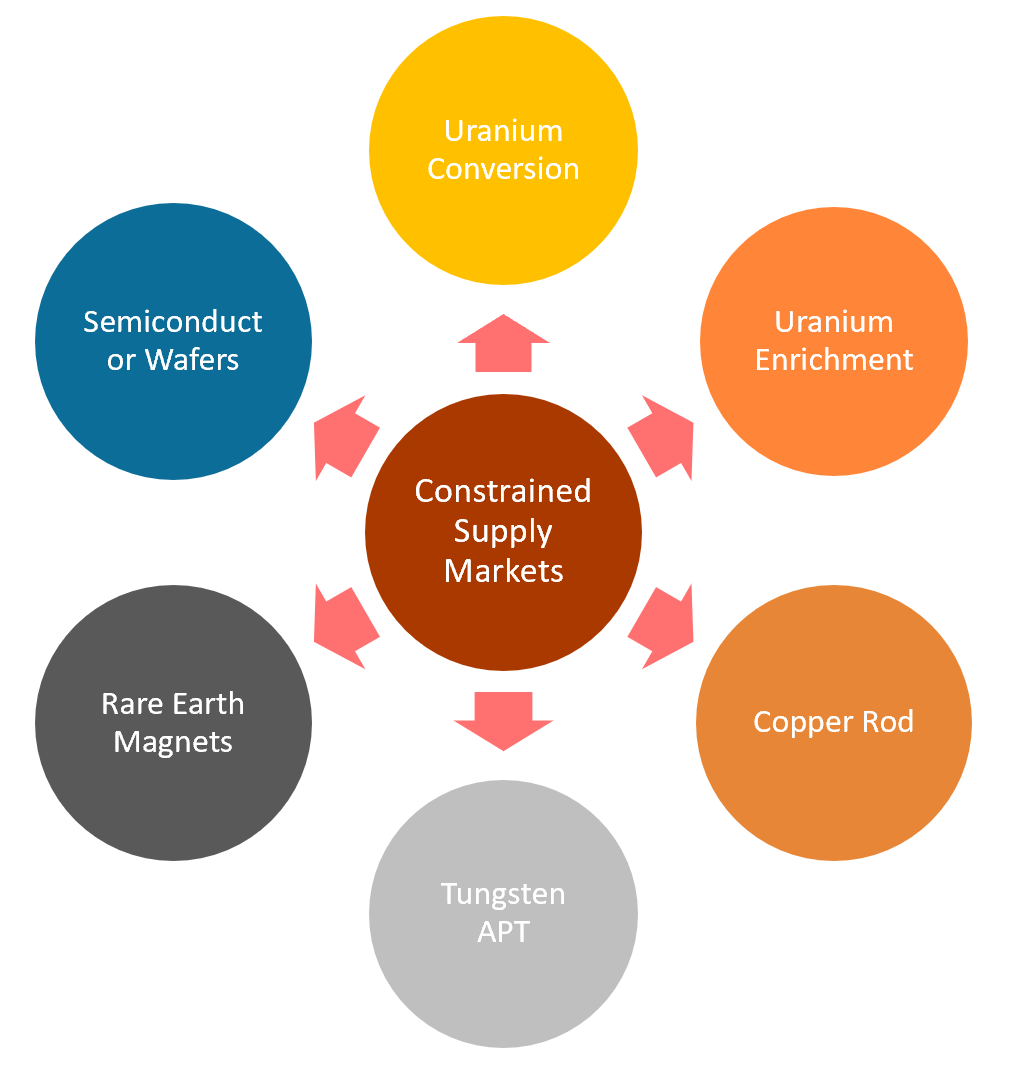
Allocation mechanisms appear wherever capacity becomes scarce.
Four Common Allocation Rule Archetypes
-
Pro-Rata Allocation
- All customers share the shortage.
- A supplier experiencing a 20% shortfall reduces deliveries proportionally across its customer base.
Outcome: Everyone receives less.
-
Priority Allocation
- Strategic customers receive protected baseline volumes before remaining production is distributed elsewhere.
Outcome: Preferred customers receive greater delivery assurance.
-
Quota Caps
- Buyers are prevented from rapidly increasing orders above historical consumption levels.
Outcome: Hoarding and opportunistic buying are restricted.
-
Capacity Anchoring and Offtake Rights
- Customers support new capacity through long-term commitments, prepayments, or investment support.
Outcome: Early access to future production capacity.
How Preferred Customer Status Becomes Physical Supply
Tiered Allocation
In a constrained market, suppliers frequently establish customer tiers.
Strategic customers may receive guaranteed baseline volumes before remaining capacity is distributed across lower-priority accounts. Transactional customers are more likely to absorb deeper reductions when available supply falls short of demand.
Pro-Rata Curtailment Protection
Not all customers are treated equally during shortages.
Strategic customers often negotiate volume floors, minimum allocation provisions, or preferential treatment before proportional reductions are applied to the remaining volume pool.
Flex Rights and Upward Quantity Tolerance
In a constrained market, flexibility becomes scarce.
The ability to increase scheduled volumes at contract pricing becomes a valuable allocation asset. Strategic customers often retain access to discretionary capacity that is unavailable to purely transactional buyers.
New Capacity and Offtake Rights
When suppliers expand conversion, enrichment, processing, or manufacturing capacity, existing strategic customers frequently gain priority access.
The value is not the contractual wording itself.
The value is access to capacity before the broader market begins competing for it.
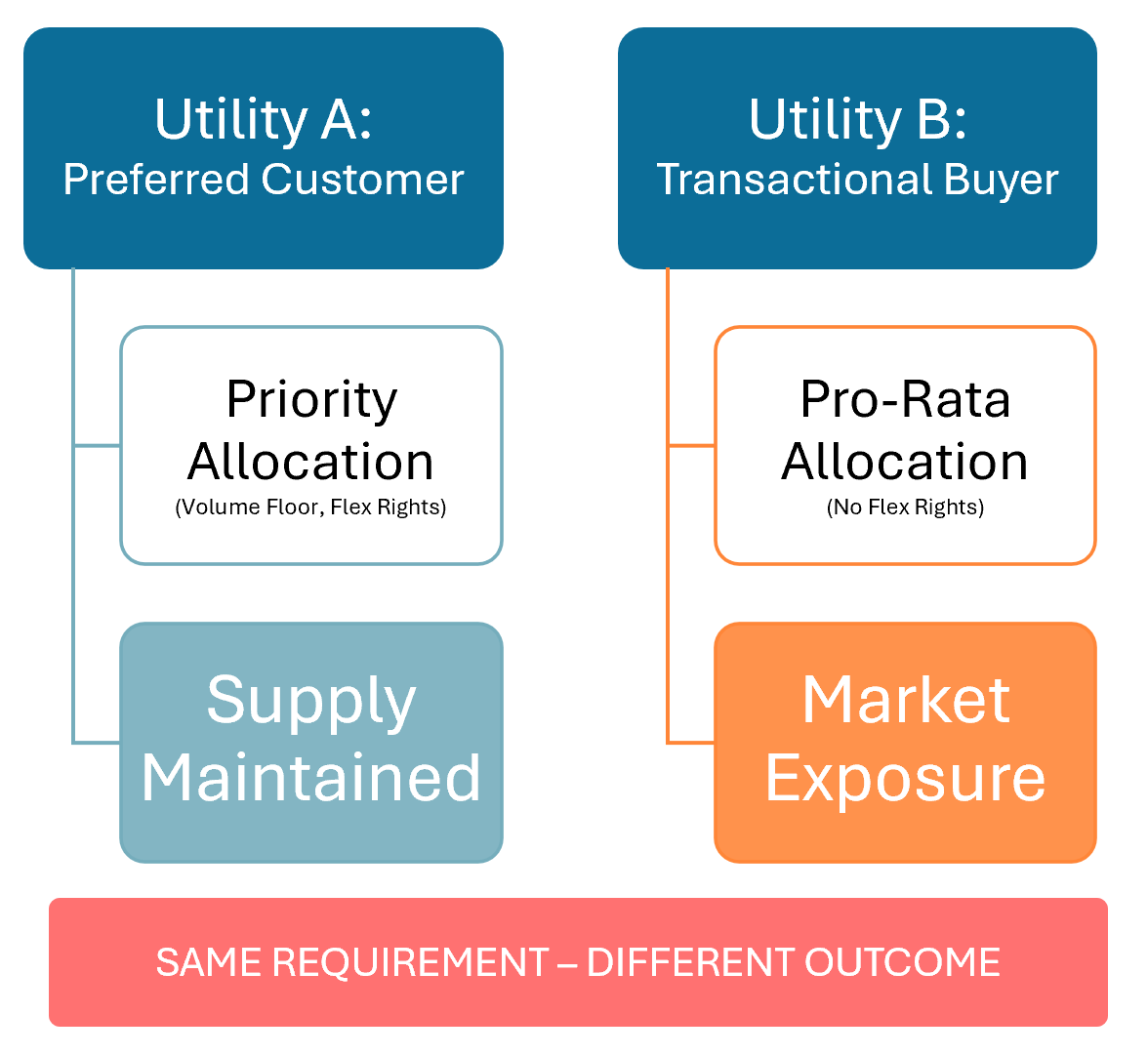
The economic value of allocation protection becomes visible only during periods of constraint.
Allocation Protection Has Economic Value
The mistake many organizations make is treating allocation protections as legal language rather than economic assets.
In a balanced market, allocation clauses attract little attention because supply is readily available. In a constrained market, those same clauses can create substantial financial value.
This value is not unique to nuclear fuel.
A utility protected from conversion curtailment, a cable manufacturer protected from copper rod allocation, and a defence contractor protected from a forging shortage all benefit from the same mechanism:
Better access to constrained supply than competitors relying on the short-term market.
Consider two utilities with identical fuel requirements:
- Both have contracts.
- Both face the same converter or enricher disruption.
One utility benefits from priority allocation, volume floors, and flex rights.
The other operates under standard pro-rata provisions.
Operationally, both utilities have supply contracts.
Commercially, their outcomes may be very different.
The first utility continues receiving most or all of its planned deliveries.
The second utility may be forced into the short-term market, draw down strategic inventory, or accept increased supply risk.
The difference is not created by the disruption itself.
The difference is created by the allocation protections already embedded in the supplier relationship.
Security Creates Three Sources of Value
- Avoided Replacement Cost: Priority allocation reduces the likelihood of replacement purchases in constrained markets where prices frequently exceed long-term contract levels.
- Avoided Operational Disruption: Reliable delivery reduces the need for schedule changes, emergency sourcing activities, inventory drawdowns, and operational workarounds.
- Preserved Optionality: Flex rights, priority access, and first-right-of-refusal provisions create access to capacity that may not be available elsewhere. The option itself can have value even when it is never exercised
The Commercial Question
Every allocation protection consumes supplier flexibility.
- Priority allocation forces deeper reductions elsewhere.
- Flex rights require reserve capacity.
- First-right-of-refusal limits future marketing flexibility.
For that reason, allocation protections are rarely free.
They are typically purchased through:
- Longer contract commitments
- Multi-cycle demand visibility
- Larger volume commitments
- Operational predictability
- Strategic partnerships
- Prepayments or co-investment
- Relationship capital
The question is therefore not:
Can we negotiate stronger allocation protections?
The real question is:
Is the cost of those protections lower than the cost of being exposed to allocation risk?
The Universal Constrained-Market Principle
Whether the material is enriched uranium, copper cathode, tungsten carbide, a semiconductor wafer, a transformer, or a specialist aerospace component, the pattern is the same.
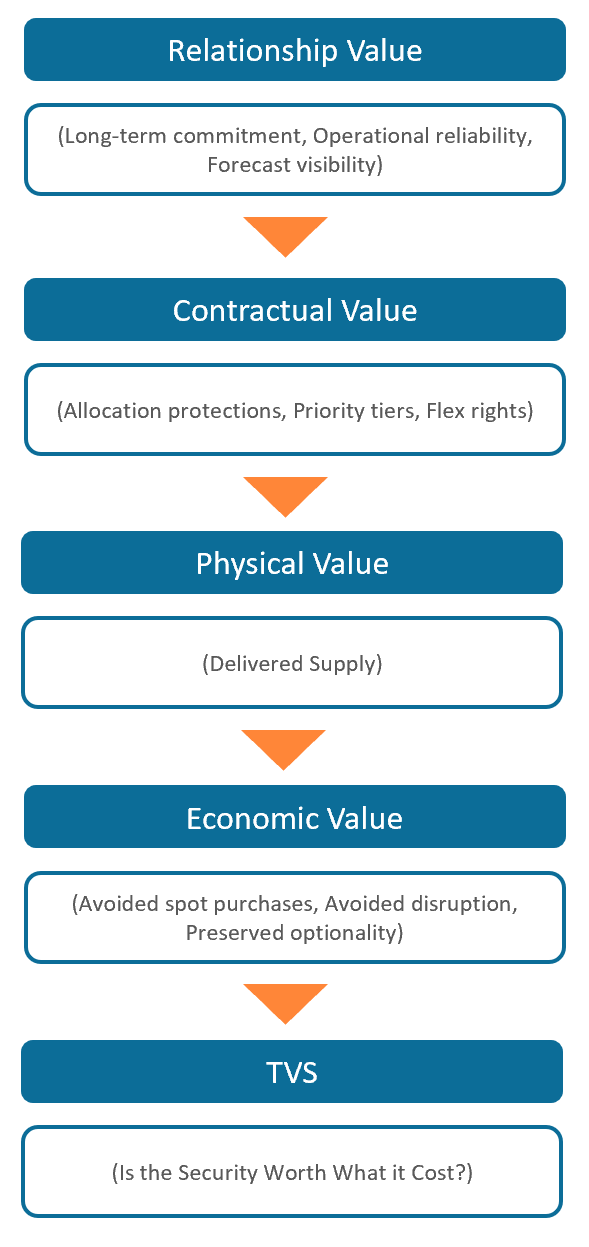
Relationship Value Becomes Security Value
When markets are unconstrained, these distinctions matter little.
When capacity becomes scarce, suppliers decide who receives volume first, who receives volume later, and who receives less volume altogether.
The buyer’s task is not simply to negotiate a contract. It is to understand which allocation protections have been secured, what they cost, and whether they are worth paying for.
Relationships determine what is commercially negotiable. Allocation rules determine what is contractually protected. Economic value determines what those protections create. TCS determines whether they are worth paying for.
Nuff said …
Further reading: TCS Prism™ · TCS Engine · TCS Advisory · Preferred Customer Status