

From theoretical risk to board-ready economic outcomes — how leading fuel buyers measure, justify, and optimize the true cost of supply resilience.
Introduction: The Nuclear Renaissance Meets Procurement Reality
Across North America, policy makers are increasingly positioning nuclear energy as a cornerstone of long-term energy security, grid reliability, and decarbonization. New reactor projects, life extension programs, small modular reactor (SMR) initiatives, and ambitious net-zero commitments all signal growing demand for reliable nuclear fuel supply.
Yet, as explored in our recent analyses — From Policy to Procurement and the featured brief on Uranium Procurement Strategy in a Constrained Supply World — policy ambition does not automatically translate into secure fuel access. Structural constraints in conversion, enrichment, and the broader fuel cycle, combined with a fundamental shift toward a seller’s market, are reshaping the procurement landscape.
In this environment, traditional procurement metrics often fall short. Utilities can describe their exposure and outline risk mitigation steps, but many struggle to answer the critical executive question:
What is fuel security actually worth?
This gap — between operational resilience and financial language understood by boards, CFOs, and treasury teams — is where procurement leadership becomes decisive. The Total Cost of Security (TCS™) Framework was developed to bridge it.
Rather than treating inventory, contracting premiums, supplier diversification, and security buffers as isolated decisions, the TCS™ Framework evaluates their combined economic impact. It helps transform fuel security from a technical or risk-management discussion into a quantifiable, defensible strategic proposition.
Why Traditional Procurement Metrics Fall Short
Nuclear fuel procurement has long relied on familiar indicators such as months forward burn, coverage percentages, weighted average cost of acquisition (WACA), supplier diversity, inventory levels, market exposure, and Value at Risk (VaR) assessments.
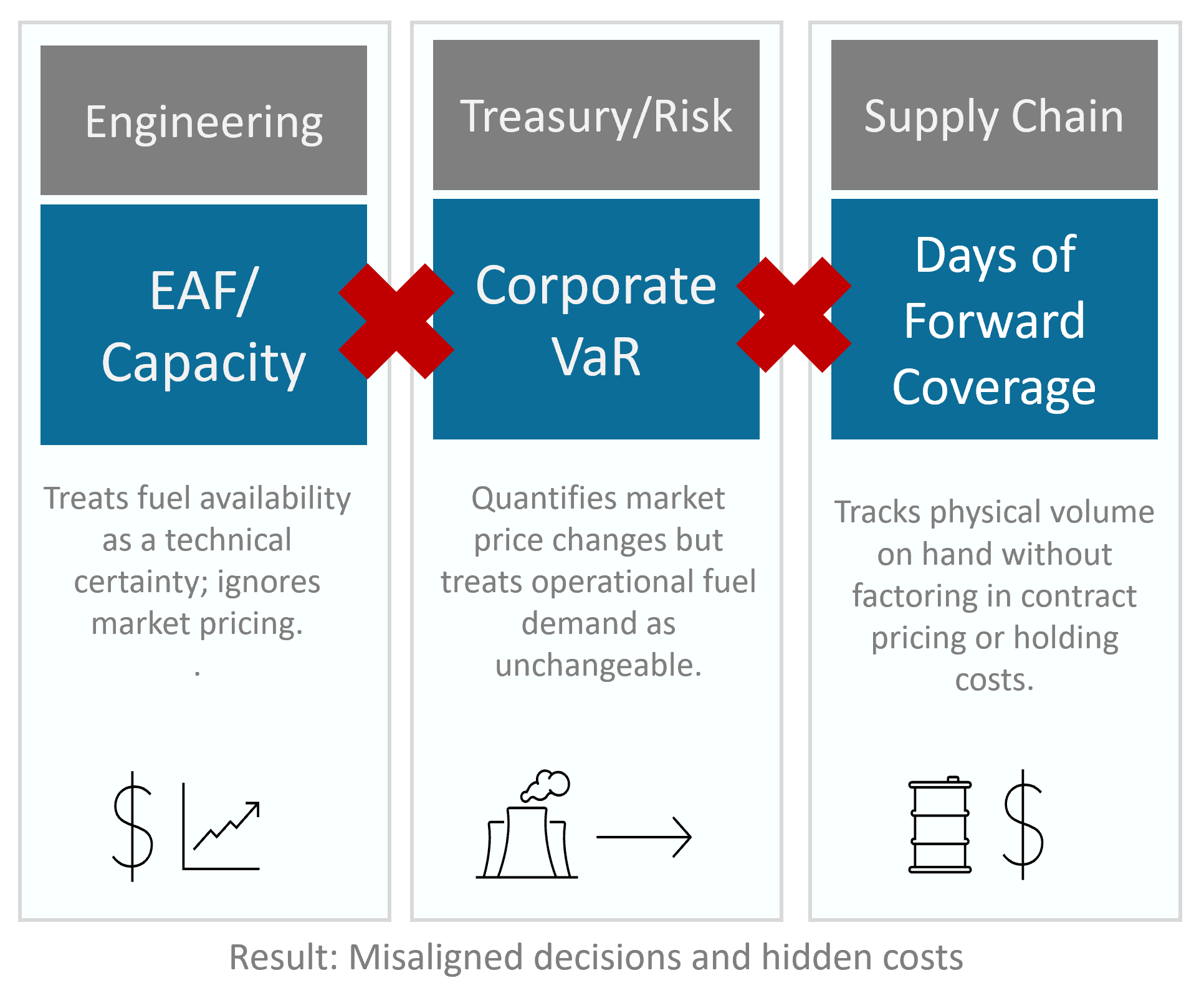
Traditional Fuel Procurement Metrics
These metrics remain valuable for tactical oversight. However, they typically measure individual elements of a strategy rather than its overall economic effectiveness. They rarely answer key board-level questions:
- What does our current security approach truly cost?
- How much value has it delivered under prevailing market conditions?
- Is the chosen level of resilience economically justified?
- How do alternative strategies compare across different future scenarios?
Compounding the challenge is the integrated nature of fuel cycle risk. Strong uranium positions can still leave exposure in conversion or enrichment. Geopolitical factors and tightening capacity across the cycle demand a more holistic view — one that connects physical security decisions with measurable economic outcomes.
Introducing the Total Cost of Security (TCS™) Framework
The TCS™ Framework provides a structured approach to measuring the economics of nuclear fuel security. It focuses on four interconnected perspectives that together offer a comprehensive view of strategy performance:

TCS™ Framework
- Total Cost of Security (TCS™) — Captures the full annual cost of maintaining a chosen security posture, including both contractual commitments and physical supply measures.
- Security Value Delivered (SVD™) — Quantifies the economic benefit realized from prior procurement decisions, particularly as market conditions tighten.
- Net Security Position (NSP™) — Assesses the overall economic benefit (or gap) by relating value delivered to the cost of security.
- Security Efficiency Ratio (SER™) — Evaluates how effectively security investments generate returns, providing a familiar investment-style benchmark.
TCS™ Boardroom Shield
Together, these metrics create a Boardroom Shield™ — a common financial language that aligns procurement, operations, finance, risk, and executive leadership. Instead of debating inventory levels or contract terms in isolation, teams can discuss the net economic contribution of their security strategy in clear, outcome-oriented terms.
Practical Application in a Multi-Reactor Fleet
Consider a utility managing a multi-reactor fleet with significant annual fuel requirements. Under a traditional approach, the organization might evaluate its position primarily through coverage ratios, inventory days, and average acquisition costs.
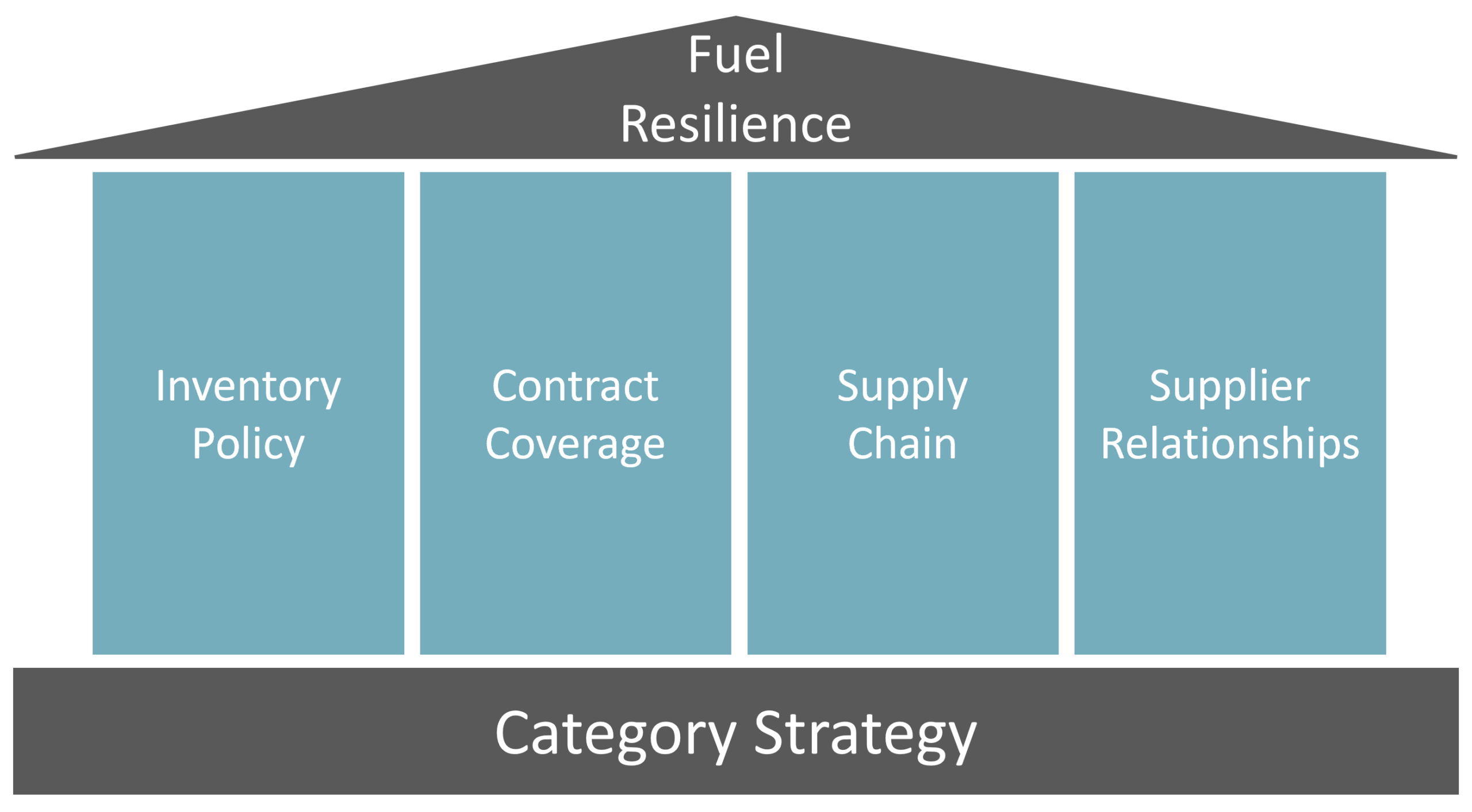
TCS™ Fuel Resilience Pillars
Using the TCS™ Framework, the same team can assess an enhanced security strategy — one that incorporates greater forward coverage, strategic inventory buffering, a broader supply-chain across allied sources and crucially, enhanced strategic supplier relationships.
The framework reveals the interplay between security costs and value creation. It enables scenario analysis across stable, tightening, and stressed market conditions, highlighting how different strategies perform as uranium prices, availability, or fuel cycle constraints evolve.
One particularly practical output is a break-even analysis: the market conditions under which the security measures become economically self-sustaining. This type of insight supports more confident decision-making on inventory policy, contracting structures, and long-term supplier relationships.
Crucially, the framework underscores that security value is highly context-dependent. A strategy that appears costly in benign markets can deliver substantial net benefits when supply constraints intensify — precisely the environment many utilities now face.
Strategic Implications for Uranium Buyers
This approach has several important implications for procurement leadership:
- Fuel procurement is becoming a core strategic function, directly tied to operational continuity and enterprise risk management.
- Inventory and contracting decisions should be evaluated as resilience assets, not merely working capital or cost items.
- Integrated fuel cycle visibility is essential — uranium sourcing cannot be managed in isolation from downstream conversion, enrichment, and logistics risks.
- Cross-functional alignment improves dramatically when security economics are expressed in shared financial terms.
Looking ahead to 2030 and beyond, competitive advantage in nuclear fuel procurement will increasingly belong to organizations that excel not only at securing volumes, but at quantifying, optimizing, and governing the economics of that security.
Implementation Pathways and Getting Started
Organizations can engage with the TCS™ Framework at varying levels of depth:
- Understand the Market — The strategic brief Uranium Procurement Strategy in a Constrained Supply World provides foundational analysis and introduces core concepts.
- Understand Your Position — The TCS Executive Toolkit™ enables teams to assess their current security economics using secure, locally deployed models.
- Evaluate Alternatives — The TCS Engine™ supports advanced scenario modeling and comparative strategy analysis, complete with board-ready outputs.
- Validate Critical Decisions — Strategic Advisory offers expert onboarding, customization, and independent review tailored to specific fleet profiles.
Each pathway is designed with security and practicality in mind, allowing sensitive commercial data to remain internal.
Conclusion
In an increasingly constrained uranium market, understanding supply dynamics is essential — but it is no longer sufficient. Leading fuel buyers are moving beyond traditional metrics to quantify the true economics of security.
The Total Cost of Security (TCS™) Framework equips procurement teams with the language and tools to measure value, evaluate trade-offs, and defend strategic decisions at the highest levels. It supports a shift from price optimization alone toward balanced, resilient, and economically sound fuel supply strategies.
The future of nuclear fuel procurement will be defined by those who can secure access, manage integrated risks, and clearly articulate the economic rationale behind their security investments.
Quantify security. Measure value. Defend decisions.
Nuff said…
Related Resources:
- Understand the Market: Insight Brief™
- Understand Your Position: TCS Executive Toolkit™
- Evaluate Alternatives: TCS Engine™
- Compare TCS™ Capability Options
- Validate Critical Decisions: Strategic Advisory™